 X / Twitter
 Facebook
 LinkedIn
 Reddit
About Trace
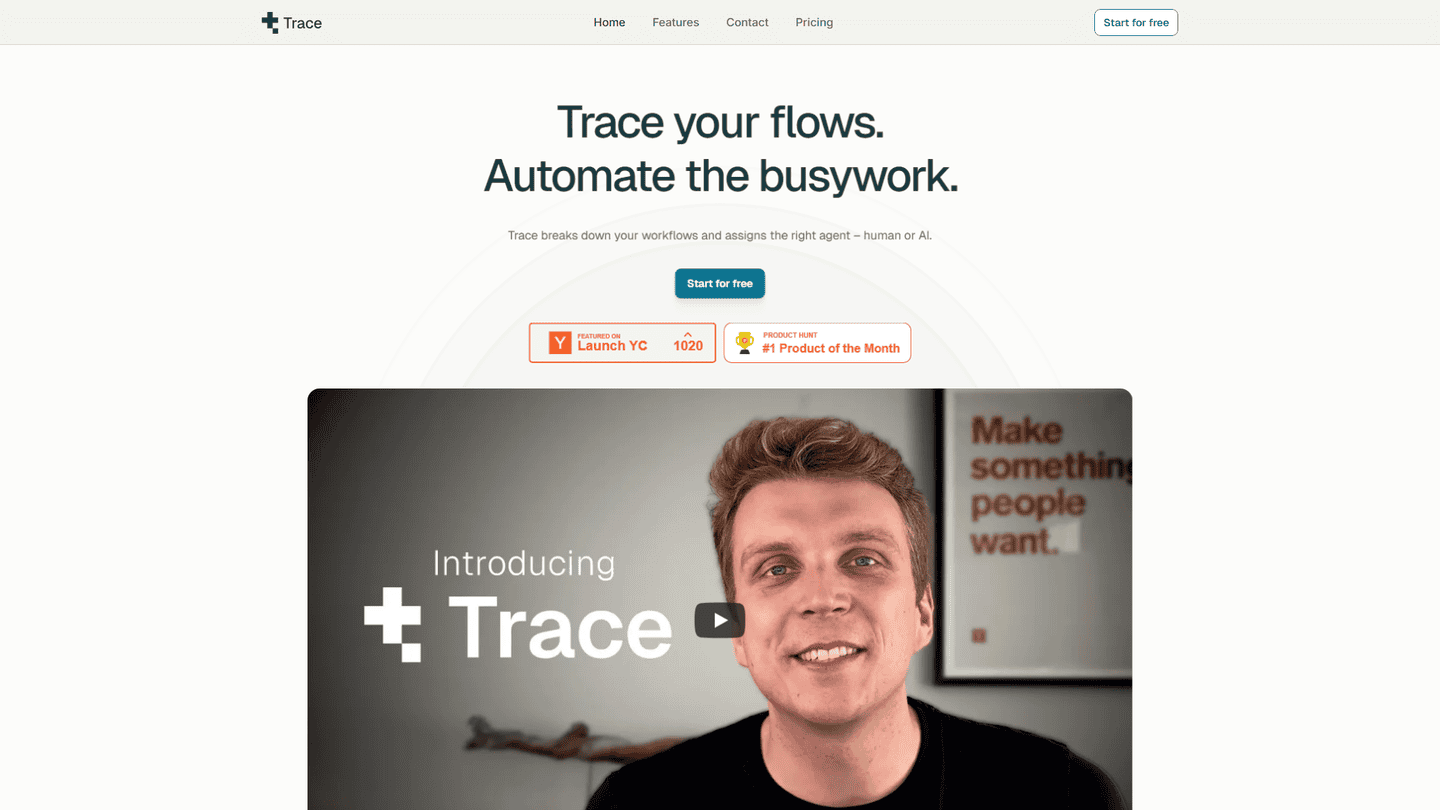
Trace is an intelligent workflow automation platform designed to optimize how businesses operate by combining human expertise with AI efficiency. It analyzes organizational workflows, identifies repetitive tasks, and assigns them to the most suitable agent—human or AI—ensuring work gets done faster and with greater accuracy.
With drag-and-drop functionality, prebuilt AI components, and community-driven workflow templates, Trace allows teams to build, customize, and scale AI-driven automation effortlessly. Its features include parallel execution of tasks, human-in-the-loop governance, detailed logs with reruns, granular permissions syncing, and intelligent triggers for real-time execution.
By unifying data, applications, and people into one high-context system, Trace delivers meaningful AI-powered automation without disrupting existing processes. Teams can deploy their own agents (BYOA), orchestrate workflows at scale, and seamlessly integrate with third-party tools.
Trusted by startups and enterprises alike, Trace helps organizations supercharge productivity, save countless hours of repetitive work, and focus on higher-value activities.
With drag-and-drop functionality, prebuilt AI components, and community-driven workflow templates, Trace allows teams to build, customize, and scale AI-driven automation effortlessly. Its features include parallel execution of tasks, human-in-the-loop governance, detailed logs with reruns, granular permissions syncing, and intelligent triggers for real-time execution.
By unifying data, applications, and people into one high-context system, Trace delivers meaningful AI-powered automation without disrupting existing processes. Teams can deploy their own agents (BYOA), orchestrate workflows at scale, and seamlessly integrate with third-party tools.
Trusted by startups and enterprises alike, Trace helps organizations supercharge productivity, save countless hours of repetitive work, and focus on higher-value activities.
Pros
- intelligent task routing
- drag-and-drop workflow builder
- prebuilt AI components
- scalable automation
- human-in-the-loop control
- parallel execution for efficiency
- community-curated templates
- robust permission syncing
- detailed workflow logs
- plug-and-play integrations
Cons
- may require initial setup and integration effort
- dependent on AI accuracy for complex tasks
- learning curve for advanced customization
- heavy reliance on third-party integrations
- pricing details not clearly specified