
 X / Twitter
 Facebook
 LinkedIn
 Reddit
About Agent Cloud
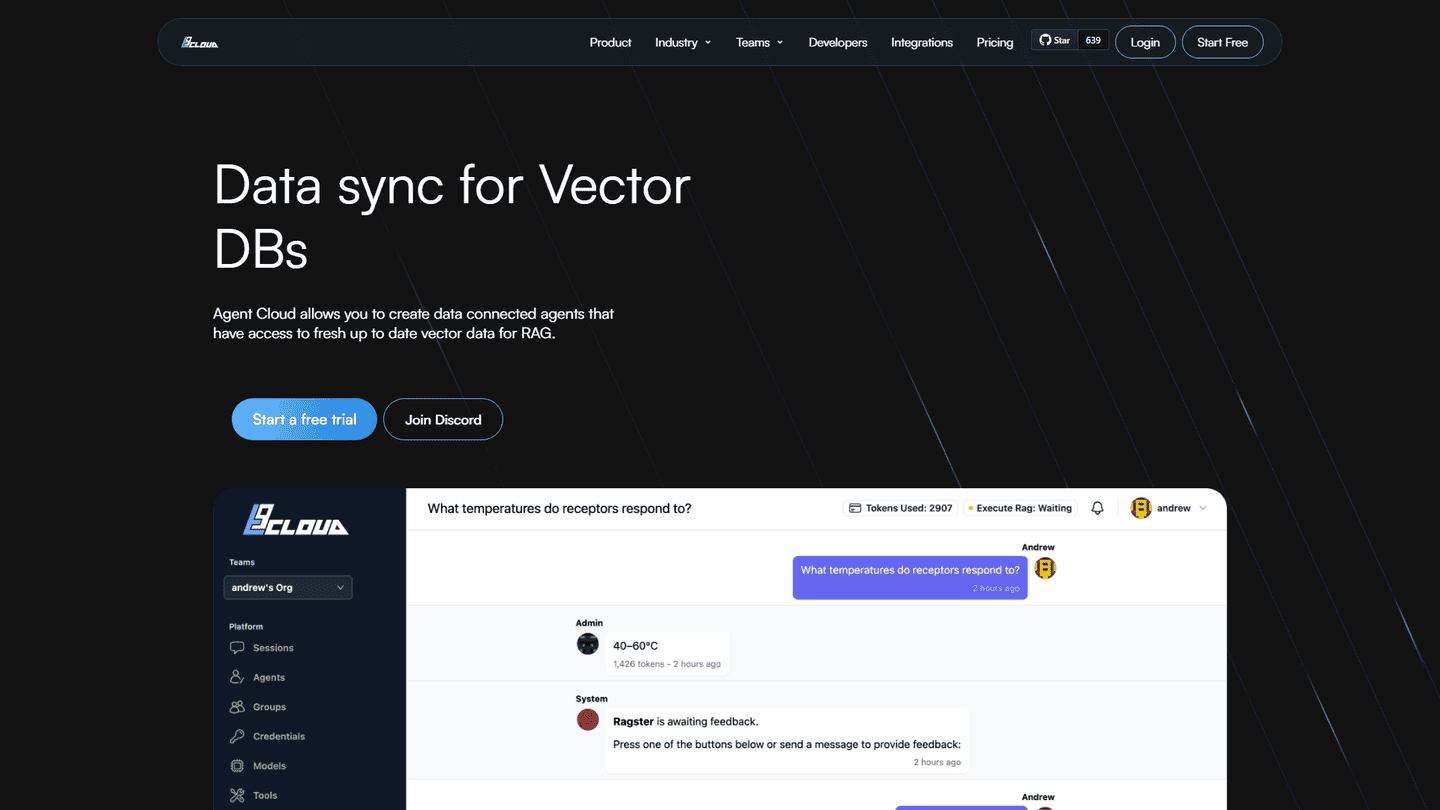
Agent Cloud is an open-source platform designed to enable companies to build, deploy, and engage with private LLM (Large Language Model) chat applications. These applications allow teams to engage in secure conversations with their data, enhancing data accessibility and insights. The platform is compatible with both open-source and Cloud-hosted LLM, which makes it model agnostic. This means users can connect their own open-source model or leverage tools like Open AI. To ensure enhanced privacy, users can connect Agent Cloud to their locally hosted models. With built-in support for data from over 300 sources, the platform minimizes integration hassles enabling the easy chunking, splitting, and embedding of data. Conversations with data are made possible by syncing, storing, and then constructing chat sessions using your choice of LLM. The platform's data pipeline is automated and can be set to manual, scheduled, or a cron expression, ensuring fresh and updated source data. In terms of infrastructure, Agent Cloud has a modular open-source architecture designed to scale seamlessly with your organization. This includes a built-in ELT pipeline powered by Airbyte, a message bus powered by RabbitMQ, and a Vector Database powered by Qdrant. Users thereby have access to a scalable, secure, and versatile platform for creating sophisticated AI applications while ensuring that their private data remains private.
Pros
- Open-source platform
- LLM chat applications
- Allows secure data conversations
- Compatible with open-source
- cloud-hosted LLM
- Model agnostic
- Supports local models hosting
- Data from 300+ sources
- Minimizes integration hassles
- Offers data chunking
- splitting
- embedding
- Automated data pipeline
- Manual
- scheduled
- cron expression updates
- Modular open-source architecture
- Scales with organization
- ELT pipeline powered by Airbyte
- Message bus powered by RabbitMQ
- Vector Database powered by Qdrant
- Trusted by renowned organizations
- Use open-source or cloud-hosted LLM
- Retrieve data from 300+ sources
- Built-in data pipeline
- Bring your own LLM
- End to end RAG pipeline
- Select your own data connectors
- Customizable data preparation
- Automated data storage in vector DB
- Sync data at user-defined frequency
- Chat with your synced data
- Designed to scale from startup to enterprise
- Built-in ELT pipeline
- Built-in message bus
- Built-in Vector Database
- Private data chat in your cloud
- Support for local Large Language Models
- Support for cloud models
- Local embedding models support
- Advanced chunking methods
- Custom fields selection for data sync
- Control over sync frequency
- Supports various file upload formats
Cons
- Requires significant RAM
- Limited OS compatibility
- Requires manual data splitting
- Chunking strategies not customizable
- Table and field selection limited
- Sync frequency requires manual configuration
- Limited file upload formats
- No Windows native support
- Needs large data infrastructure
- Data access through specific sources
Common Questions
What is Agent Cloud?
Agent Cloud is an open-source platform that equips businesses with the tools to construct, initiate, and engage with private Large Language Model (LLM) chat applications. This enables secure discussions with data, enhancing data accessibility and insights.
What are the main features of Agent Cloud?
Key features of Agent Cloud include the ability to build and deploy LLM chat applications, data accessibility from over 300 sources, an automated data pipeline, and a modular open-source architecture. Built-in ELT pipeline powered by Airbyte, a message bus powered by RabbitMQ, and a Vector Database powered by Qdrant are also notable features. Agent Cloud provides options for data to be set to manual, scheduled, or a cron expression to ensure fresh and updated source data. Moreover, users can connect Agent Cloud to locally hosted models.
How can Agent Cloud be used to build private LLM Chat apps?
Building private LLM Chat apps with Agent Cloud involves connecting to either an open-source model or utilizing an external tool such as Open AI. The platform accommodates conversations with data by syncing, storing, and subsequently creating chat sessions using the selected LLM. Users can leverage their own models hosted locally for increased privacy or opt for cloud-hosted models. The platform has been engineered to work seamlessly with either option, describing it as being 'model agnostic'.
How does it ensure data remains private in chats?
To ensure that data stays private in chats, users can connect Agent Cloud to their locally hosted models. This means the data is stored and managed within the infrastructure of the user, thus enhancing privacy. Agent Cloud thus enables the creation of sophisticated AI applications that offer privacy for their data.
What does it mean when Agent Cloud is described as model agnostic?
'Model agnostic' means that the platform is flexible and can work with any model, whether open-source or cloud-hosted. Users can connect Agent Cloud to their own open-source model, or even utilize other tools like Open AI, providing flexibility and versatility.
How does the platform handle data from various sources?
Agent Cloud has built-in support that allows users to minimizes integration hassles and manage data from over 300 sources. It enables the easy chunking, splitting, and embedding of data, providing an efficient way to handle diverse data.
What is the purpose of the data pipeline in Agent Cloud?
The data pipeline in Agent Cloud is a systematic process designed to move data through various transformations, from its raw, unprocessed state to a usable format. The pipeline comes with the options to set the frequency of data sync to manual, scheduled, or a cron expression. This ensures that the data utilized is always fresh and updated.
How does Agent Cloud's modular architecture work?
Agent Cloud's modular architecture is an open-source structure that is designed to scale along with the organization's growth. It has a built-in ELT pipeline powered by Airbyte, a message bus powered by RabbitMQ, and a Vector Database powered by Qdrant. All these elements contribute to the scalability and adjustability of the platform.
Can I connect Agent Cloud to locally hosted models?
Yes, users can connect Agent Cloud to locally hosted models. This feature ensures enhanced privacy for data and allows companies to employ their own open-source model or leverage tools like Open AI.
What is the use of the ELT pipeline in Agent Cloud?
The Extract, Load, Transform (ELT) pipeline in Agent Cloud powered by Airbyte is part of the integral infrastructure. This pipeline enables the processing of data, where it extracts data from a source, loads it into a database, and then transforms it into a usable state.
What is the role of RabbitMQ in Agent Cloud functionality?
RabbitMQ plays a significant role in Agent Cloud as it powers the message bus. This functionality is what makes the communication between different components of the platform possible, ensuring smooth transmission of information or data within the platform.
What is the meaning of Vector Database powered by Qdrant in Agent Cloud infrastructure?
A Vector Database powered by Qdrant in Agent Cloud refers to the database structure used to store and manage the vector data within the platform. Its role involves handling vector data in an efficient and flexible manner, contributing to the overall versatility of the data management system.
Can I use both open-source and cloud-hosted LLM with Agent Cloud?
Yes, Agent Cloud is compatible with both open-source and cloud-hosted Large Language Models (LLM). It provides flexibility for users to use their own open-source model or leverage tools like Open AI.
How does Agent Cloud ensure data security?
Agent Cloud ensures data security by enabling users to connect it with locally hosted models, ensuring the protection of proprietary data due to the localized management. It also employs secure conversations with data to reinforce data security.
What does it mean by LLM chat applications?
LLM chat applications are chatbots or applications powered by Large Language Models. These are machine learning models that are trained on large amounts of text data and can generate human-like text. In the context of Agent Cloud, these applications enable secure discussions with data, enhancing data accessibility and insights.
Is Agent Cloud scalable according to the size and needs of an organization?
Agent Cloud is indeed scalable and designed to grow seamlessly with an organization. With its modular open-source architecture, companies can seamlessly scale their AI applications as per their evolving needs.
Why does Agent Cloud use tools like Open AI?
Agent Cloud uses tools like Open AI to provide users with the flexibility of leveraging highly advanced and capable AI tools while constructing their chat applications. The platform's compatibility with such tools ensures users can construct sophisticated and robust chatbots.
What advantages does Agent Cloud offer in terms of data integration?
Agent Cloud offers significant advantages in terms of data integration. With built-in support for data from over 300 sources, it simplifies integration difficulties, allowing for easy chunking, splitting, and embedding of data.
What role does syncing plays in constructing chat sessions using my choice of LLM?
Syncing plays a crucial role in determining how updated the data used in the chat sessions is. Syncing in Agent Cloud allows the platform to consistently access the most recent data source for use in the LLM chat applications. This ensures the information conveyed in chat sessions is accurate, relevant, and up-to-date.
Can I automate the data pipeline on Agent Cloud?
Yes, the data pipeline in Agent Cloud can be automated. It can be set to manual, scheduled, or a cron expression, ensuring continuous and up-to-date source data.